Why Signage Manufacturers Face Bonding Failures—and How the Right Instant Adhesive Prevents Them
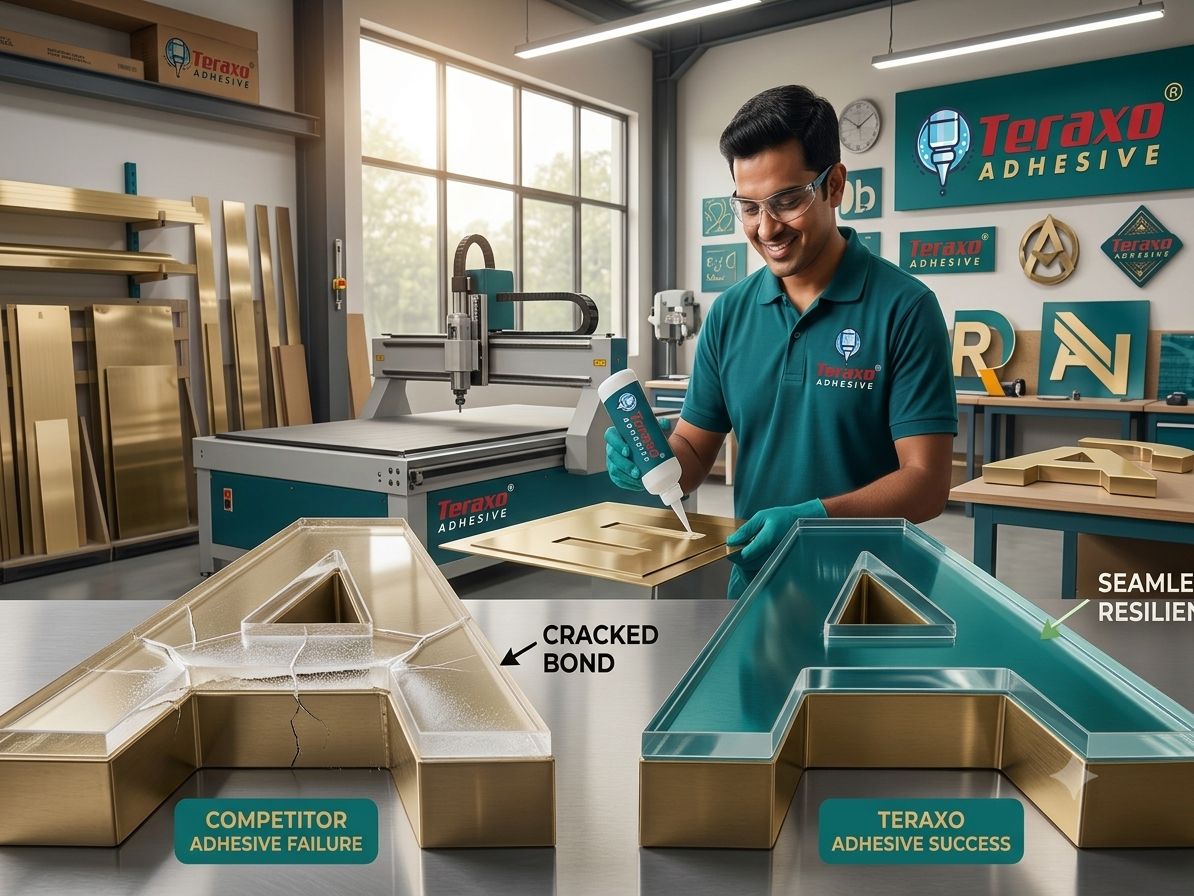
Walk into any signage fabrication unit and you'll notice the same recurring complaint: letters popping off acrylic panels, ACP sheets delaminating at the edges, flex boards curling away from frames, and PVC foam boards cracking at the bond line within weeks of installation. For an industry where the finished product hangs outdoors, faces monsoons, direct sun, and temperature swings, a weak bond isn't a minor inconvenience—it's a brand liability, a safety hazard, and a costly rework cycle.
Most signage manufacturers assume bonding failure is a material problem. In reality, it's almost always an adhesive selection problem. The wrong glue—or the right glue used the wrong way—is responsible for the majority of premature sign failures across acrylic letters, ACP cladding, PVC foam boards, and flex-faced boards.
This post breaks down exactly why these failures happen and how choosing the right instant adhesive for signage manufacturing eliminates them at the source.
The Real Cost of a Bonding Failure in Signage
Before getting into causes, it's worth understanding what a failed bond actually costs a signage business:
- Site revisits and labor to re-fix fallen letters or peeling panels
- Material wastage when a panel has to be re-fabricated
- Reputational damage when a client's storefront sign looks shabby within months
- Warranty claims that eat into already-thin margins
- Safety risk, especially with large acrylic letters or ACP panels mounted at height
A single tube of the wrong adhesive can trigger all five. That's why serious fabricators are moving away from generic, multipurpose glues and toward industrial instant adhesives engineered specifically for signage substrates.
Why Signage Bonds Fail: The Five Real Culprits
1. Substrate Mismatch — One Glue, Many Materials
Signage work rarely involves a single material. A single job might combine acrylic letters, an ACP backing sheet, PVC foam board standoffs, and a flex-printed face. Each of these has a different surface energy, porosity, and flexibility.
A general-purpose adhesive optimized for porous materials will struggle on smooth acrylic. A rigid adhesive that works beautifully on ACP will crack the moment it's used on a flexible PVC or flex board joint that needs to absorb thermal movement. Manufacturers who use one "all-purpose" adhesive across every substrate are, statistically, setting themselves up for failure on at least one of them.
The fix: Use a premium instant adhesive formulated to bond dissimilar substrates—acrylic to metal, PVC to composite, flex to frame—without needing a different product for every material.
2. Poor Gap-Filling and Flexibility
Acrylic letters mounted on ACP sheets are rarely a perfectly flush fit. There's almost always a small gap or unevenness at the bond line. Rigid, brittle adhesives fill this gap but crack under vibration, wind load, or thermal expansion—especially on outdoor signage exposed to direct sunlight.
The fix: An adhesive with the right combination of fast fixture time and flexible cured bond line handles minor gaps and continues to absorb stress instead of snapping.
3. UV and Weather Degradation
This is the single biggest differentiator between indoor-grade and true outdoor signage adhesives. Standard cyanoacrylates degrade under prolonged UV exposure, turning brittle and yellow, and losing adhesion strength within a season. Combine that with monsoon humidity or coastal salt air, and a bond that looked perfect at installation fails within 6–12 months.
The fix: Choose an instant adhesive specifically tested for UV resistance, humidity resistance, and temperature cycling—not a repurposed craft or stationery-grade glue.
4. Slow Cure Time Disrupting Production Flow
In a signage workshop, speed is money. Fabricators applying adhesive to hold acrylic letters or flex board joints in position need near-instant grab strength so the piece doesn't shift before final positioning. Slow-curing adhesives force workers to hold, clamp, or tape pieces for minutes at a time—killing throughput and introducing alignment errors.
The fix: A true instant adhesive, like Teraxo's FX40 Instant Adhesive, delivers rapid fixture time so operators can bond and move to the next piece within seconds, without compromising final bond strength.
5. Inconsistent Application and Surface Prep
Even the best adhesive fails if it's applied inconsistently—too thin on porous PVC foam board, too thick on smooth acrylic, or onto a dusty/oily surface straight off the CNC router. Many manufacturers don't realize that surface contamination (cutting dust, mold-release residue, fingerprints) is a silent cause of "adhesive failure" that isn't actually an adhesive problem at all.
The fix: Pair the right adhesive with basic surface prep discipline (clean, dry, dust-free surfaces) and a consistent bead/dot application pattern for even coverage.
What to Look for in a Signage-Grade Instant Adhesive
If you're evaluating adhesives for a signage production line, here's the checklist that separates a reliable industrial instant adhesive from a generic one:
| Requirement | |
| Multi-substrate bonding | Works across acrylic, ACP, PVC, foam board, and metal without switching products |
| Fast fixture time | Keeps production lines moving; reduces clamping and rework |
| UV & weather resistance | Essential for outdoor signage exposed to sun, rain, and heat |
| Flexible cured bond | Absorbs vibration and thermal expansion without cracking |
| Low odor / low whitening (blooming) | Keeps acrylic and clear surfaces looking clean at the bond line |
| Consistent viscosity | Enables precise application on vertical and horizontal joints |
Matching the Right Adhesive to Each Signage Material
Acrylic letters: Need an acrylic bonding adhesive with minimal blooming (white haze) so the transparent or glossy finish isn't ruined at the joint. Fast tack is critical since letters are often held by hand during positioning.
ACP sheets: Aluminum composite panels need strong adhesion between metal skins and the polymer core edge, plus resistance to the panel's natural rigidity and thermal expansion at large spans.
PVC foam boards: A dedicated PVC sign board adhesive (or PVC & UPVC adhesive) is essential here—foam board is porous and lightweight, and adhesives designed for hard plastics alone often don't penetrate or grip it properly.
Flex boards and flex-faced signage: A flex board adhesive needs flexibility above all—flex material moves with wind and temperature, and a rigid glue line will simply tear away from the substrate over time.
Outdoor signage assemblies: Regardless of substrate, anything installed outdoors needs adhesive rated for UV stability and moisture resistance, not just indoor bond strength.
This is exactly why generic hardware-store cyanoacrylates consistently underperform in commercial signage manufacturing—they're built for occasional household repairs, not daily industrial-scale bonding across five different materials in variable outdoor conditions.
Why Manufacturers Are Switching to Teraxo's FX40
Teraxo's FX40 Instant Adhesive was developed specifically to address the substrate-mismatch and weather-degradation problems that plague signage production. It's built as a premium instant adhesive for fabricators who can't afford callbacks or warranty claims:
- Bonds acrylic, ACP, PVC foam board, and flex substrates reliably without switching formulations
- Fast fixture time that matches the pace of high-volume signage production
- Formulated for durability against UV exposure, humidity, and temperature swings typical of outdoor installations
- Minimal blooming on clear and glossy acrylic surfaces
- Consistent, workshop-friendly viscosity for precise application
For manufacturers producing acrylic letters, illuminated signage, ACP cladding, or flex-faced boards at scale, standardizing on one dependable signage adhesive simplifies inventory, training, and quality control—while cutting the failure rate that generic adhesives can't avoid.
Final Thoughts
Bonding failures in signage are rarely about bad luck or low-quality substrates—they're almost always about using an adhesive that wasn't built for the substrate, the environment, or the production pace. Acrylic letters, ACP sheets, PVC foam boards, and flex boards each demand different bonding characteristics, and outdoor exposure raises the stakes further.
The signage manufacturers who eliminate rework, warranty claims, and site revisits are the ones who've stopped treating adhesive as an afterthought and started treating it as a core part of their production quality—choosing a purpose-built instant adhesive for signage manufacturing instead of whatever glue happens to be on the shelf.
Ready to eliminate bonding failures in your signage production line? Explore Teraxo's FX40 Instant Adhesive and our full range of industrial bonding solutions at teraxo.co.in.