Why More Furniture Manufacturers Are Switching from Conventional Wood Glue to Instant Bonding Solutions
In the competitive world of modern furniture manufacturing, efficiency, precision, and production throughput dictate profitability. For decades, Polyvinyl Acetate (PVA) and traditional resin-based glues served as the standard wood adhesive for furniture manufacturing. However, as consumer demand shifts toward custom cabinetry, flat-pack furniture, and rapid lead times, conventional wood glues have increasingly exposed a major operational bottleneck: extended cure times and extensive clamping requirements.
To eliminate these constraints, forward-thinking furniture plants and commercial carpentry facilities are transitioning toward high-performance instant wood adhesive systems. Powered by advanced cyanoacrylate wood adhesive formulas, these rapid-bonding solutions enable manufacturers to secure joints in seconds, streamline floor space, and significantly lower labor costs.
Here is a deep dive into the industry trends driving this migration, the core operational advantages of instant bonding, and how sourcing from a specialized wood adhesive manufacturer provides a distinct competitive edge.
The Industrial Trend: Moving Beyond Curing Bottlenecks
Traditional wood glues require anywhere from 30 minutes to several hours of continuous pressure under clamps before assemblies can be handled or transferred to the next machining stage. In a high-volume manufacturing facility, this waiting period creates three major friction points:
- Floor Space Clutter: Hundreds of clamped sub-assemblies sitting on factory floors consume valuable square footage that could otherwise be dedicated to active assembly or CNC operations.
- Capital Tied Up in Tooling: Maintaining dozens of mechanical clamps, hydraulic presses, and specialized jig rigs increases capital expenditures and maintenance overhead.
- Production Line Stagnation: Downstream steps—such as sanding, laminating, hardware installation, and finishing—are forced to halt until the wood adhesive achieves full handling strength.
By integrating an industrial wood adhesive that cures almost instantly upon contact, manufacturers transition from batch-and-wait processing to continuous, single-piece flow workflows.
Key Operational Benefits of Instant Bonding Solutions
1. Seconds-Fast Fixture Times
When paired with an aerosol activator (accelerator), a high-grade cyanoacrylate wood adhesive achieves handling strength in 3 to 10 seconds. Operators can align components, press them together briefly, and immediately pass the unit to the next stage without waiting for glue lines to set.
2. High Versatility Across Substrates
Engineered wood products like Medium-Density Fiberboard (MDF), particleboard, and plywood present varying porosity levels that absorb liquid glues unevenly. Formulated as a targeted adhesive for MDF/plywood/laminate, instant cyanoacrylate formulas—especially medium and high-viscosity gels—stay on the bond line rather than soaking into porous end-grain, resulting in clean, uniform bonds.
3. Elimination of Joint Slippage
Under heavy mechanical clamp pressure, wet PVA glue acts as a lubricant, often causing wood parts to shift slightly off-square. Using an instant adhesive for wood joinery locks joints precisely in place the moment contact is made, eliminating tedious re-alignment steps.
4. Dual-Adhesive (Hybrid) Production Efficiency
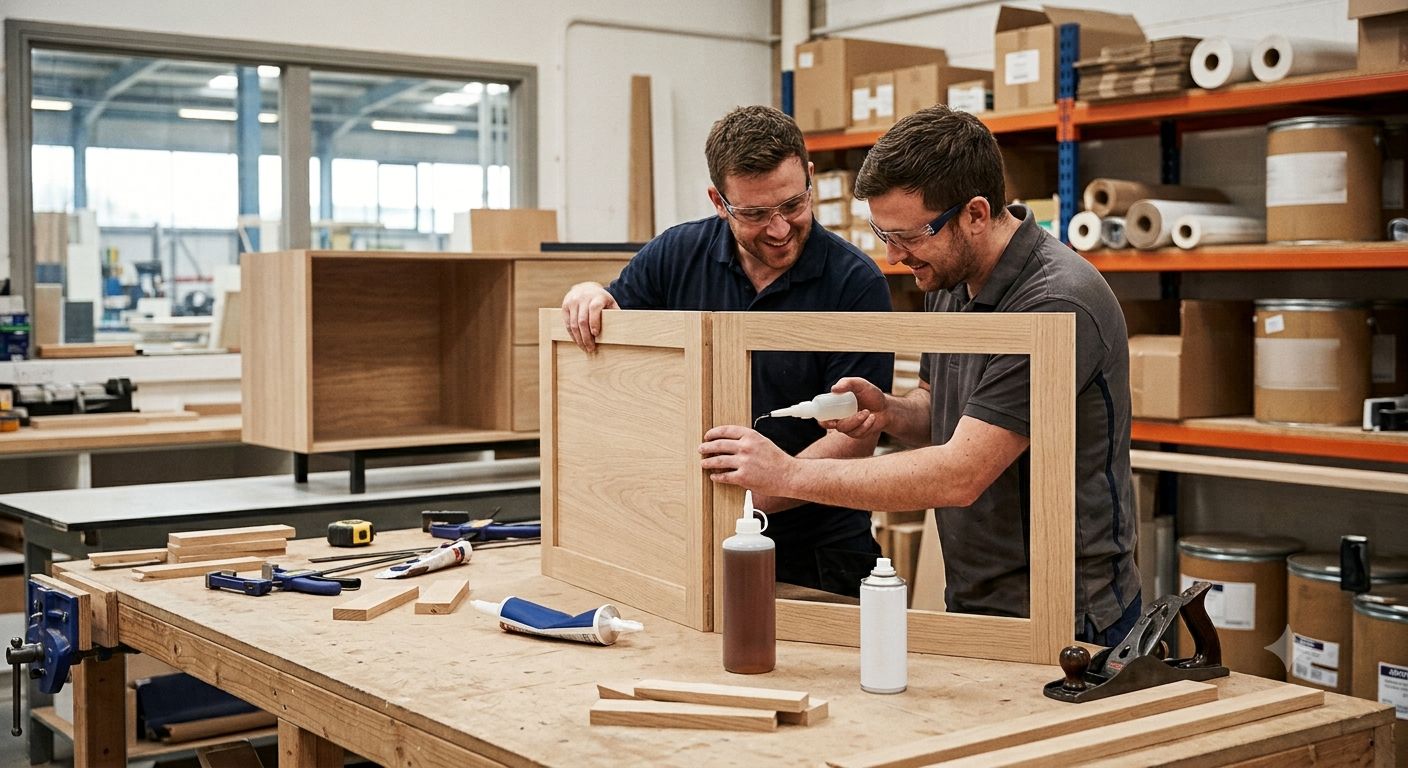
Many manufacturers use instant adhesives in tandem with traditional structural glues. By applying PVA down the center of a joint and placing small dabs of cyanoacrylate at the ends, the instant glue acts as a "liquid clamp." This temporary hold retains structural alignment immediately while the slow-curing PVA cures in the background—completely removing physical clamps from the assembly line.
Specific Furniture Applications Where Instant Glues Excel
"Instant adhesives transform complex corner mitres and decorative trim installation from a multi-person, multi-clamp hassle into a single-operator, five-second task."
High-Speed Joinery & Mitre Corners
Traditional mitre joints (picture frames, cabinet face frames, decorative crown moldings) are notoriously difficult to clamp without specialized angle blocks. Instant cyanoacrylates allow woodworkers to spray one face with activator, apply glue to the mating face, and bring them together for an immediate 90-degree bond.
Edge Banding & Laminate Repair
When automatic edge-banding machinery misses a corner or an edge lifting occurs on laminates, stopping the machine halts the entire line. Technicians use high-viscosity instant glues to perform flush, seamless spot repairs within seconds, keeping the automated line running without downtime.
Architectural Millwork & Fastener-Free Trim Attachment
For premium, high-end furniture where visible nail holes ruin the grain aesthetic, instant adhesive eliminates the need for pneumatic brad nails or pin tackers when attaching decorative trims, moldings, and side panels.
Partnering with the Right Industrial Wood Adhesive Manufacturer
To fully capture the cost savings of instant bonding, furniture factories must look beyond off-the-shelf retail glues. Partnering with an experienced wood adhesive manufacturer ensures access to industrial-grade formulations engineered specifically for automated dispensers, varied viscosity needs (from thin liquids for tight dowels to thick gels for porous MDF), and non-blooming chemistries that prevent white haze on dark wood veneers.
Frequently Asked Questions (FAQs)
What is the best adhesive for MDF, plywood, and laminate furniture assembly?
High-viscosity cyanoacrylate wood adhesive combined with an aerosol activator is widely considered the best solution for quick assembly on MDF, plywood, and laminates. The gel consistency prevents the adhesive from being absorbed into porous wood edges, while the activator guarantees bond setting within 5 to 10 seconds.
Can cyanoacrylate instant adhesives completely replace traditional wood glue?
Cyanoacrylates excel at non-structural joinery, edge-banding repairs, trim installation, and fixture positioning. However, for heavy load-bearing structural joints (such as chair legs or main cabinet frames), manufacturers often combine instant adhesives with PVA or polyurethane glues to leverage instant handling alongside long-term dynamic stress resistance.
How does an instant adhesive for wood joinery work without mechanical clamps?
Instant adhesives cure rapidly through a chemical reaction triggered by ambient surface moisture and accelerated by specialized spray activators. Because the reaction creates initial handling strength within seconds, hand pressure for 5 seconds replaces the need for mechanical clamps.
Why should furniture manufacturers work directly with a specialized wood adhesive manufacturer?
Working directly with an industrial wood adhesive manufacturer gives factories access to custom viscosities, bulk packaging (tubes, bottles, or automated dispensing system drums), optimized cure speeds, and technical support tailored specifically to engineered wood substrates like MDF and high-pressure laminates.