
Where Manufacturers Lose Time During Wood Assembly
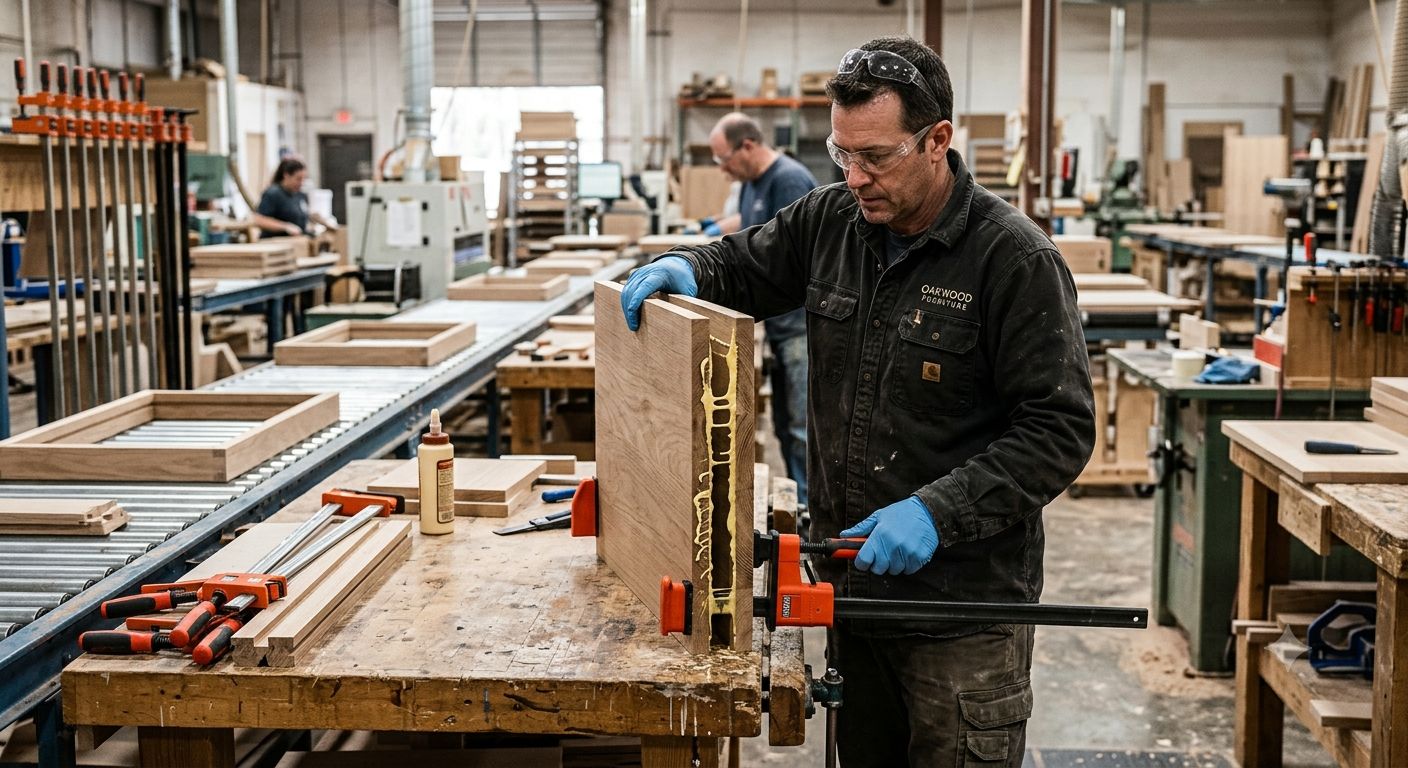
Where Manufacturers Lose Time During Wood Assembly
Walk through almost any furniture or joinery workshop and you'll notice the same bottleneck repeating itself: production doesn't slow down because of cutting, sanding, or finishing. It slows down at the glue station. Wood assembly — the step where panels, joints, edges, and laminates are bonded together — is often the single biggest hidden drain on manufacturing time.
The Real Time Sink: Waiting, Not Working
Most manufacturers assume their biggest losses come from machine downtime or labor shortages. In reality, a large share of production hours simply disappear while parts sit in clamps or jigs, waiting for conventional adhesives to cure. Depending on the adhesive type, this can mean:
- 20–40 minutes of clamp time per joint for standard wood glues
- Entire batches held up because one bonded assembly can't be moved
- Clamps and jigs tied up instead of being reused for the next job
- Operators standing idle, or shifted to lower-value tasks, while they wait
When you multiply this across hundreds of joints a day, "waiting for glue to dry" quietly becomes one of the largest line-item costs in the entire production schedule — even though it never shows up as a distinct expense on paper.
Other Common Time Losses in Wood Assembly
Beyond curing time itself, a few related issues compound the problem:
- Inconsistent bond strength — leading to rework, re-gluing, or rejected parts further down the line.
- Multi-step adhesive prep — mixing ratios, pot life limits, and temperature sensitivity that slow down the operator before bonding even starts.
- Material-specific failures — general-purpose adhesives that don't bond well to MDF, plywood, or laminate surfaces, causing delamination later.
- Clamp and jig dependency — production capacity effectively capped by how many clamps you own, not how many workers you have.
How Fast-Curing Adhesives Change the Equation
This is where fast-curing adhesives — particularly cyanoacrylate-based (instant) wood adhesives — make a measurable difference. Instead of clamping a joint for 20–40 minutes, fast-curing systems can set in seconds to a few minutes, depending on the substrate and joint type.
The impact on a production floor is direct:
- Faster part-to-part cycle time — bonded assemblies can be handled and moved almost immediately.
- Fewer clamps needed per shift — because each clamp is freed up much sooner, the same set of jigs supports higher throughput.
- Lower rework rates — many fast-curing formulations are engineered for strong initial grab, reducing joint slippage before full cure.
- Better performance on engineered wood — formulations designed specifically for MDF, plywood, and laminate bonding reduce the delamination issues common with generic adhesives.
- Simplified handling — no mixing, shorter pot life concerns, and more consistent results across operators and shifts.
For manufacturers running tight production schedules or working with just-in-time delivery commitments, shaving minutes off every single joint adds up to hours saved per shift — and often translates directly into higher daily output without adding labor or floor space.
Choosing the Right Adhesive for the Job
Not every fast-curing adhesive is interchangeable. The right choice depends on:
- Substrate — solid wood vs. MDF vs. plywood vs. laminate surfaces each have different porosity and bonding behavior.
- Joint type — edge joints, lap joints, and laminate bonding all place different demands on cure speed and flexibility.
- Production environment — humidity, temperature, and line speed all affect real-world cure performance.
- Load requirements — furniture joinery that will bear structural weight needs adhesives engineered for durability, not just speed.
Working with an adhesive manufacturer that understands wood joinery specifically — rather than a general-purpose industrial adhesive supplier — usually results in fewer surprises during scale-up