What Every Modular Kitchen Manufacturer Should Know Before Choosing an Instant Adhesive
Modular kitchens live and die by their finish. A cabinet front can have perfect carcass work and hardware, but if the laminate lifts at a corner or an edge profile peels after six months of steam and scrubbing, that's what the customer remembers. The adhesive holding those laminates, edge bands, trims, and PVC accessories together is doing more structural work than most manufacturers give it credit for — and it's often the last thing evaluated on a bill of materials, when it should be one of the first.
Here's what actually matters when you're choosing an instant adhesive for modular kitchen production.
Laminates and edge profiles need different bonding behaviour than plain wood
Kitchen shutters combine several materials on a single panel: MDF or particleboard substrates, decorative laminates, PVC or acrylic edge banding, and often ABS or aluminium trims. Each of these surfaces cures and grips differently. A general-purpose wood glue that works fine on solid timber can under-perform on a glossy laminate or a low-surface-energy PVC edge, leaving a bond that looks fine on day one and fails at the seam months later.
This is where a dedicated PVC Bonding Adhesive earns its place on the line. Cyanoacrylate-based instant adhesives formulated specifically for PVC and laminate surfaces grip low-energy plastics far more reliably than standard wood adhesives, and they cure fast enough to keep a laminating or edge-banding line moving without clamping stations eating up floor space and cycle time.
Whitening and blooming are a bigger risk than manufacturers expect
One failure mode that's specific to kitchen manufacturing is visible whitening or "blooming" around the bond line — a cloudy residue that shows up especially badly on glossy laminates, acrylic shutters, and light-coloured PVC trims. It doesn't affect strength immediately, but it ruins the finish on a product that's sold on finish.
A Premium Instant Adhesive with anti-whitening chemistry solves this at the source rather than requiring rework or touch-up after assembly. Teraxo's FX40 Instant Adhesive is built around exactly this problem: it's an ethyl cyanoacrylate formulation with a zero-whitening, zero-blooming finish, a 1–3 second cure time, and enough initial tack to hold PVC, acrylic, and laminate surfaces — including glossy, matte, and textured sheets — without a visible bond line. For manufacturers doing large-surface panel bonding, that combination of speed and clean finish is what separates a professional result from a product that needs a second pass.
Installation speed is a production cost, not just a convenience
In a modular kitchen factory, adhesive cure time compounds across hundreds of panels a day. If a trim or edge profile needs 30 seconds of clamping instead of 3, that difference multiplies into slower throughput, more jigs and fixtures tied up mid-cure, and more handling damage from panels moved before the bond has set.
An Instant Adhesive for PVC Profiles designed for fast-moving production — with cure times measured in single-digit seconds — lets fabrication and assembly stay in sync instead of adhesive cure becoming the line's bottleneck. This matters just as much for PVC Fabrication Adhesive used on window and door components that share the same supply chain as kitchen accessories, since many manufacturers run both product lines through the same PVC and UPVC processing setup.
PVC windows, doors, and accessories demand adhesives built for the substrate, not adapted to it
Modular kitchen manufacturers increasingly fabricate or install PVC and UPVC components alongside cabinetry — window frames, door panels, channels, and trims that share the same factory floor. Using an Adhesive for PVC Windows & Doors that's actually formulated for UPVC chemistry, rather than a repurposed wood or general-purpose adhesive, avoids two common problems: weak adhesion on the plasticised surface of UPVC profiles, and long-term embrittlement where the bond becomes stiff and cracks under thermal cycling near windows and exterior-facing units.
A true PVC & UPVC Adhesive should be tested for both, because these profiles expand and contract with heat far more than laminate panels do, and a bond that's strong at application but brittle after a few temperature cycles will fail exactly where it's hardest to repair.
Acrylic shutters and flex-faced panels need their own bonding logic
High-gloss acrylic shutters and flex-board signage panels used in kitchen displays or point-of-sale units behave differently again — acrylic is prone to stress-cracking (crazing) if the wrong solvent-heavy adhesive is used near an edge, and flex-board materials need a bond that stays flexible rather than going rigid and cracking the printed surface.
An Acrylic Bonding Adhesive with controlled viscosity and a Flex Board Adhesive with good flexibility retention after cure are two distinct requirements, and manufacturers who use one general adhesive across acrylic, flex board, and PVC trims are usually the ones dealing with the most warranty callbacks. Matching the adhesive chemistry to the substrate — rather than standardising on whatever is cheapest per litre — is what actually reduces long-term rework cost.
Long-term durability is where cheap adhesives get expensive
Kitchens are a humid, temperature-cycling, frequently-cleaned environment. Steam from cooking, cleaning agents, and daily wear all stress a bond line long after installation. An adhesive that looks identical to a premium formulation on the shelf can behave very differently after 12–18 months of that exposure — edge bands lifting at corners, trims separating at joints, laminate delaminating near the sink or hob.
This is the practical argument for standardising on an Industrial Instant Adhesive rather than a retail-grade one for production use. Industrial-grade cyanoacrylate formulations are engineered for consistent viscosity, batch-tested curing performance, and stable shelf life — Teraxo's range, for instance, is quality-checked batch by batch with a 6–12 month shelf life window, which matters for manufacturers holding stock across a production cycle rather than buying tube by tube.
What to actually check before switching or standardising an adhesive
Before a modular kitchen manufacturer locks in an adhesive across their line, it's worth verifying:
- Substrate compatibility — confirm the adhesive is rated for the specific materials in your BOM: MDF/laminate, PVC, UPVC, acrylic, ABS trims, and any metal accents.
- Cure time versus your line speed — a 1–3 second cure product behaves very differently on a manual assembly bench versus an automated edge-banding line.
- Finish on your actual laminate stock — test for whitening or blooming on your glossiest and darkest laminate SKUs specifically, since that's where it shows up first.
- Shelf life and storage conditions — factory floors in India run hot; an adhesive's stated shelf life should be validated under your actual storage temperature, not just the label spec.
- Batch consistency — ask your supplier whether products are batch-tested for viscosity and cure time, not just spot-checked.
Where Teraxo fits into this
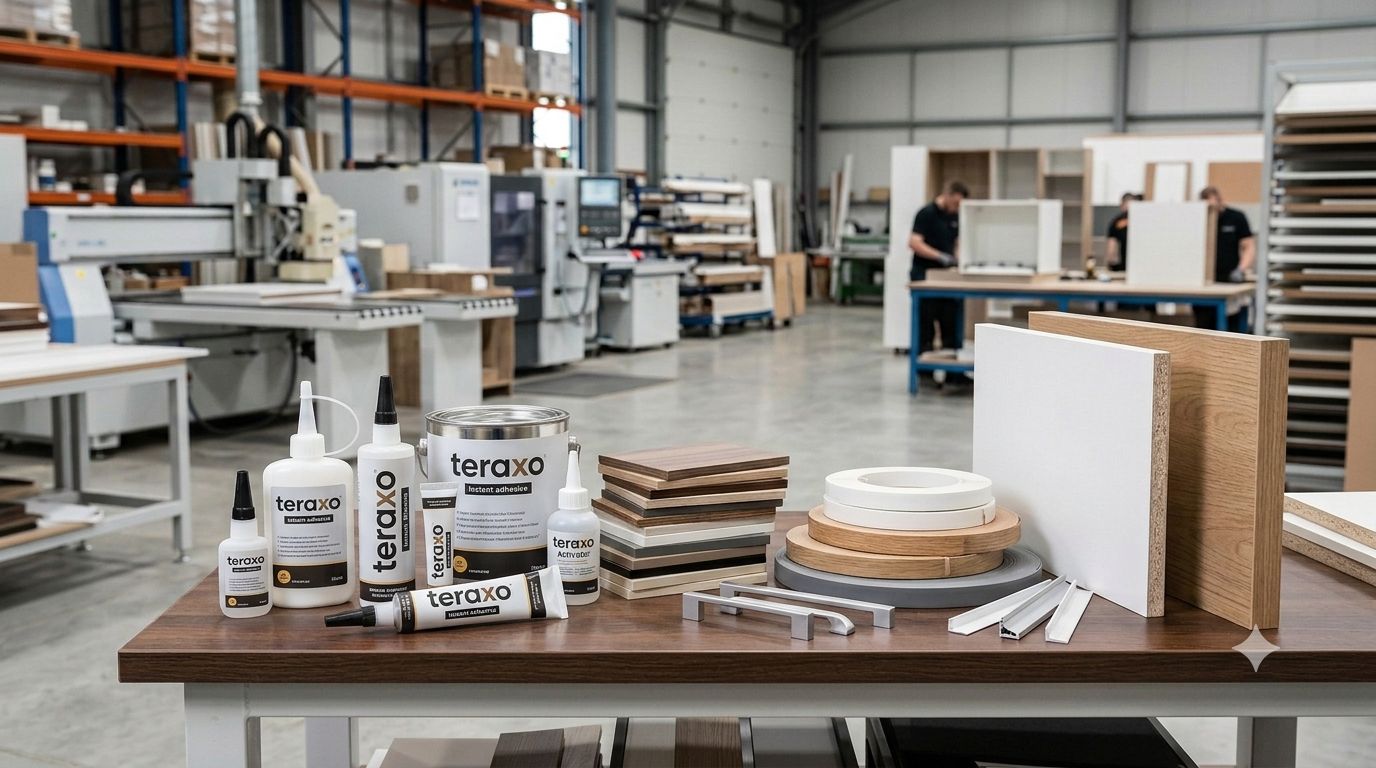
Teraxo formulates its instant adhesive range specifically for the industries that modular kitchen manufacturers overlap with — interiors and modular kitchens, PVC and UPVC fabrication, signage and flex board, and furniture and woodworking — rather than offering one generic cyanoacrylate across all of them. The FX40 Instant Adhesive (Premium Grade) is the one most relevant to laminate, PVC, and acrylic bonding on kitchen shutters and trims, with its anti-whitening formula and fast cure built for large-surface, visible-finish work. Alongside it, Teraxo's broader range covers general-purpose bonding (R40), premium wood-grade applications (W40), and high-viscosity gap-filling needs (G40), so manufacturers running mixed substrates on one line aren't forced to compromise on any single material.
If you're evaluating adhesives for a modular kitchen production line — or fabricating PVC windows and doors alongside it — it's worth requesting samples and testing directly against your own laminate and PVC stock rather than going on a spec sheet alone. Get in touch with Teraxo for product samples or a bulk quote, or browse the full product range to compare grades against your specific bonding needs.